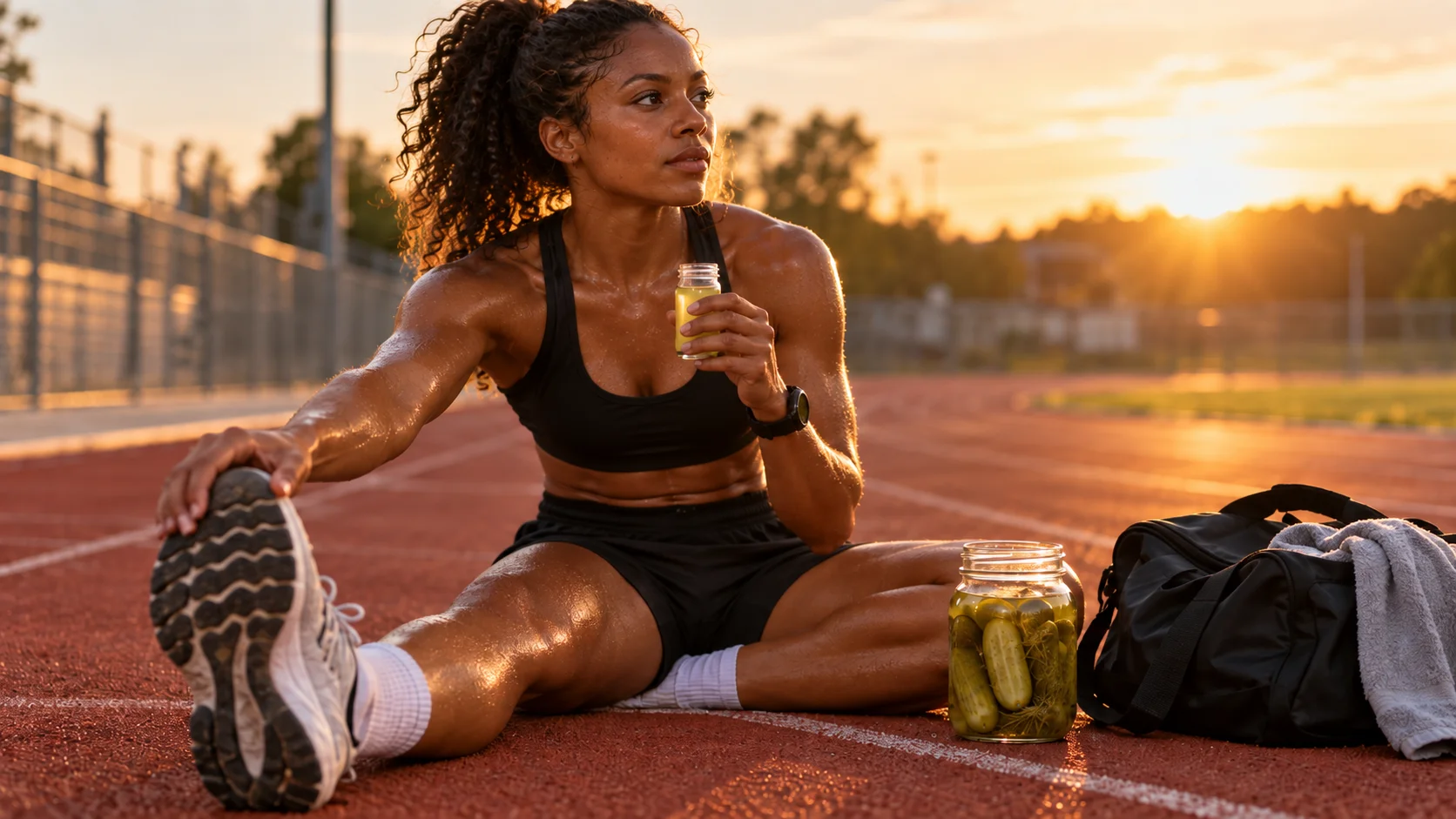
In a heat chamber at North Dakota State University, ten college-aged men pedaled stationary bikes in 41-degree Celsius air for a little over two hours until each had sweated away about 3 percent of his body mass. Then the researchers taped electrodes to the bottom of one foot, delivered a current strong enough to lock a small toe muscle into a cramp, and handed each man either nothing, a cup of deionized water, or roughly 74 milliliters of brine poured from a jar of sliced dill pickles.
The pickle brine won, and the reason it won turned out to be the opposite of what most athletes assume. "The relief of cramping by pickle juice likely represents a neurological phenomenon rather than a metabolic one," the lead author, Kevin C. Miller, then an assistant professor of health, nutrition and exercise science at NDSU, said when the study was released in June 2010.
The direct answer is that a small dose of pickle juice for muscle cramps can shorten a cramp that is already under way, by about 37 percent compared with water in that laboratory model. It does so too quickly for any salt to reach the blood, which points to a reflex triggered in the mouth and throat, and that distinction changes how and when an athlete should use it.
The Experiment That Timed the Cramp
The full paper, published in Medicine and Science in Sports and Exercise and available as a PDF, dosed the brine at 1 milliliter per kilogram of body weight. Cramps that followed a drink of pickle juice lasted 84.6 seconds on average, against 133.7 seconds after deionized water, a gap of 49.1 seconds. Against a baseline cramp with no fluid at all, the authors wrote that pickle juice relieved the cramp "45% (85 vs 153 s) faster." Individual results ranged widely, from 12 seconds to 219, a spread that matters for anyone expecting the same result every time.
The brine itself was a concentrated salt and vinegar solution with a pH of 3.15, and its reputation on sidelines rests on the theory that it replaces the sodium lost in sweat, which is the theory the blood draws were designed to test.
Why the Salt Was Not the Reason
The researchers drew blood before and after the drink and found no significant change in plasma sodium, potassium, magnesium or calcium within five minutes of either fluid. "Even more interesting," Miller said, "is that study results showed there were no significant changes in the blood following ingestion of either water or of pickle juice."
Eighty-five seconds, the authors wrote, "is not enough time for the nutrients in pickle juice to be emptied from the stomach, absorbed by the small intestines, and assimilated into the extracellular fluid compartment." Their proposed mechanism is a reflex originating somewhere in the oropharyngeal region, the back of the mouth and upper throat, possibly set off by the acetic acid in the vinegar, which in turn quiets the misfiring motor neurons that keep a cramping muscle contracted.
That framing makes the brine less a form of edible hydration in the usual sense and more a sensory signal delivered through food. The fluid volume is too small to matter for hydration status, and the sodium arrives long after the cramp has ended.
What the Newer Work Added
A Penn State team that included D.H. Craighead and W.L. Kenney tested the reflex idea directly in a 2017 study in Muscle and Nerve. Thirty-nine participants drank either a placebo or a beverage built from TRP channel agonists, compounds that excite sensory receptors in the mouth and throat, and then had calf cramps induced through voluntary contraction. Time to cramp rose from 27.8 seconds to 36.9, the electrical intensity of the cramp fell from 77.2 to 37.3 units of maximal muscle activity, and the force needed to trigger a cramp climbed from 9.9 kilograms to 13.8. Motor and dexterity tests in 31 of the participants were unaffected.
The Australian Institute of Sport now lists these tastants, pickle juice included, in Group B of its supplement framework, the tier for products with emerging evidence that deserve further research. Its suggested protocols are 1 milliliter per kilogram of pickle juice or a 50-milliliter commercial shot flavored with capsaicin, ginger, cinnamon or lime, taken 15 minutes before exercise or at the first sign of a cramp. The institute also notes that laboratory results have not yet been demonstrated in real competition, that strong flavors can upset the stomach, and that no consensus dose exists.
A 2026 hypothesis and theory paper in Frontiers in Sports and Active Living by M. Hales and J.D. Johnson II pushed the argument further, stating that "hydration and electrolyte explanations do not adequately account for many cramping events" and pointing to a case-control study of 433 Ironman triathletes that linked cramp history to higher race intensity and a family history of cramping. The paper proposes a framework and does not report new experimental data.
Most Cramps Are Not a Fluid Problem
The field evidence lines up with the lab. A prospective study of 210 Ironman triathletes by Martin Schwellnus and colleagues in the British Journal of Sports Medicine, followed the 43 who cramped and found that the only independent predictors were a faster race time and a previous history of cramping. Serum electrolytes and changes in body weight were no different between the athletes who cramped and those who did not, and the authors wrote that their results "add to the evidence that dehydration and altered serum electrolyte balance are not causes for EAMC," the clinical shorthand for exercise-associated muscle cramps.
Ron Maughan and Susan Shirreffs reached a cautious middle position in a 2019 Sports Medicine review, describing two competing explanations, disturbed water and salt balance on one side and abnormal spinal reflex activity driven by fatigue on the other, and concluding that of the treatments proposed, "none are consistently effective."
The National Athletic Trainers' Association, in a 2015 position statement on exertional heat illness that counts Miller among its authors, keeps both doors open. "The cause of EAMCs is not fully confirmed; proposed contributing factors and conditions include dehydration, electrolyte imbalances, altered neuromuscular control, fatigue, or any combination of these factors," the statement reads.
How to Use a Brine Shot
Treat the cramp first, then drink
The NATA statement sets the order of operations. "The immediate treatment for acute EAMCs related to muscle overload or fatigue is rest and passive static stretching of the affected muscle until cramps abate," it says, and it lists roughly 1 milliliter per kilogram of pickle juice as an option when the athlete tolerates it. For a 70-kilogram runner that works out to about 70 milliliters, a little under two and a half fluid ounces, sipped at cramp onset or about 15 minutes before an effort that has cramped that athlete before.
When sodium does matter
Some athletes lose a great deal of salt. The NATA statement describes cramp-prone athletes who may lose 2 to 3.4 liters of fluid an hour and 5 grams or more of sodium in a session, while also noting that their intake and sweat losses "are often comparable with those of noncramping athletes." For a heavy, salty sweater facing a long hot session, sodium-containing fluids and foods across the day are the tool, and the brine shot is a separate, faster lever. Our comparison of sodium per stick across electrolyte drink mixes and our explainer on when sessions run long enough to need electrolytes cover that side of the plan.
Who should be careful
Pickle brine is very high in sodium, and the 2010 release cautioned against drinking large amounts and advised checking with a physician first, given how common high blood pressure is among adults. Anyone with a sensitive stomach should test a small dose in training rather than on race day, because the acidity that may drive the reflex is the same property that can unsettle digestion mid-effort.
The laboratory record now spans a dill pickle jar in Fargo, a capsaicin drink at Penn State and an Ironman cohort of 210 finishers. Together they describe a cramp remedy that works through the nerves in the throat on a timescale of seconds, which is why the brine belongs in the pocket of a kit bag at the start line and not in the hydration plan built across the day before it.